Handleless Bags in a Functional World
There's an illusion being kept that everything is normal. This is the problem.

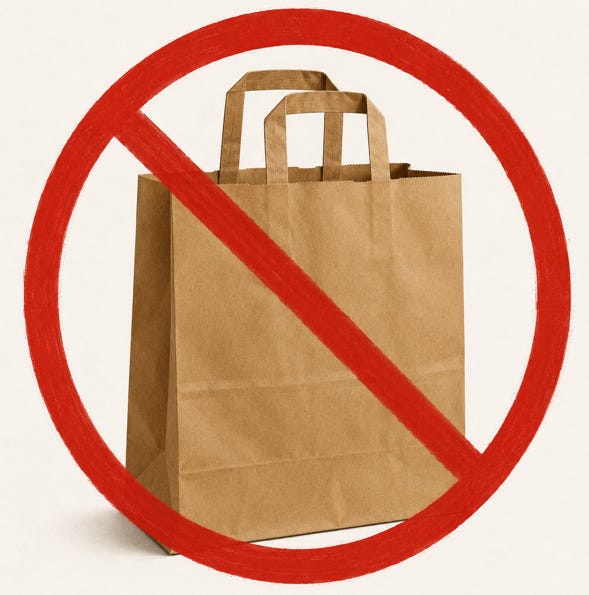
Just this past week, while in the grocery store checkout, I realized that the store-issued paper bags no longer contained handles. After pressing a few employees if there were any other options, they just shrugged and kept pointing to said handleless bags. I get that I should be bringing my own bags, which I almost always do, but I was coming straight from work and walking back home afterwards.
This, I thought, is an outrage.
It’s unclear what the corporate genius of said grocery chain was thinking when they devised this blatant cost cutting scheme, but I can assure you it’s not an individual who shops at the store themselves. Certainly not someone who has to walk through a city with said handleless bags.
Honestly, I would have preferred an even more ambitious corporate policy—no bags at all.
It would be a change so jarring that it would force me to bring my own bags every time. Or to avoid shopping at that store altogether. I’d learn the hard way, showing up with nothing to carry my groceries home with, and my behavior would change forever. The problem with the handleless bags, besides the obvious disregard for customer satisfaction, is that they’re still marginally functional. The bags still work. Kind of.
There’s an illusion being kept here. That yes, things are slightly different than before. But if you squint and get over the minor inconvenience, it’s really more or less the same.
That small distortion should worry us all.
In Jesse Ball’s 2011 dystopian novel The Curfew he depicts a totalitarian police state that governs over the fictional town of C. The citizens of C encounter many problems living under this authoritarian regime, but the most pressing being they have no idea who is a part of the government and who isn’t. It’s a shadow state, in which the rulers dress, act and behave as if they too, are normal citizens. It is therefore, in everyone’s best interest to assume everyone around you is a part of the government.
To trust no one.
Same goes with the “rule of law.” There’s no written code or publicly announced mandate that citizens are beholden to a strict curfew after dark. But those that venture out late usually disappear, or end up dead by the morning. And so no one, at least no one sane, leaves their home at night.
Ball, as he does so masterfully, describes this town with an eerie, poetic and satirical wit. There’s a genuine absurdity to the novel’s state of affairs, including the jobs and conversations those in the town engage in. But it’s what got them to this point that feels so terrifying. There was no bloody revolution, or storming of the Bastille, or defining moment that brought the town of C to its current state. Things were normal for a while, forever really, and then they weren’t normal anymore. No one remembers when the curfew was put in place. Or when the government switched from being visible to hiding in plain sight. It just slowly happened over time.
And now here they are. A shared reality that feels completely unrecognizable.
If you listen to a majority of our business leaders prognosticate on how AI will impact the labor market, they’re likely to say something along the lines of:
Everyone’s job is at risk.
The models are getting better on a daily basis. Much faster than anyone could have reasonably predicted even just a few years ago. It’s clear now that we’re on the precipice of AGI, in which human activity will more or less become irrelevant for all cognitive functions. Especially if you work in front of a computer. I know we told you, just recently, that skills like coding would be useful for you and your kids to learn, and studying topics like the humanities in college was more practical than software engineering. But now, who knows? Therefore, the best advice we can possibly give is to become an expert with the tools that are likely to replace you. And while you’re at it, would you mind not complaining so much in the meantime? You still have a job after all. Something that you should be thankful for.
*
And you know what? There’s an element of truth to this.
The models are getting better. And it’s not unreasonable to think there’ll be genuine job displacement some time in the near future. Tools are already being integrated into corporate workstreams, and middle management at firms all over the country are encouraging their employee base to adopt, or well, risk being left behind.
But I’m not worried about AI wiping out the entire job market in a matter of years.
Not because it’s unlikely (although history has taught us that technology always increases jobs rather than replaces them) but because so vast of a change in such a quick time would be such a public emergency that it would require addressing immediately. Our leaders, even the inadequate ones, wouldn’t survive an economic or political climate in which half of the labor market evaporated overnight. Something would give, and the powers that be would course correct. Or, if the utopian dream really does come true in which humans are no longer needed to produce goods, services, infrastructure and food, we would all adapt to a new normal that didn’t require showing up for “work” every week day from nine to five.
We would figure it out.
*
What worries me the most feels like the most probable outcome in this AI race—a small but impactful amount of job upheaval.
Sure, our leaders and general public would declare an emergency if unemployment reached 45% in a few year stretch. But what about 8%? What about 10%?
How is the public going to react when they personally know a handful of over qualified, hard-working knowledge-base workers who can no longer find work? How are companies going to react when their peers are continuously cutting 5-10% of their work force every few years? Is the government really going to step in and do anything if unemployment ticks up a few percentage points? Can they really do anything at all?
No one has the answer to these questions, and to me, that’s the emergency.
There’s already angst in the job market and in public discourse about AI, and that’s while we’re living in a healthy economy. Unemployment in the US remains historically low. GDP is expected to rise year over year. Consumer spending remains resilient. But it feels like we’re one change away, one sweeping announcement of a sector closure, from a crisis.
What about our current political moment?
Does it feel like Trump is going to lead us into a police state, or that we’re all going to blink and overnight have a Gulag type prison camp on our hands? Not to me it doesn’t. Trump, for one, is too small a person to have such grand ambitions. He’s much more focused on securing golf deals, on using the levers of American power to enrich himself and his family.
The worry I have with Trump is a softer worry, but one that still feels existential—a gradual erosion of democratic norms.
When Trump’s second term is over, America will more or less look and feel the same as it did ten years ago. We’ll still show up for work. We’ll still show up to the voting booth in November. We’ll still gather around the table on major holidays and cheer on our favorite sports teams. But over the past decade Trump has normalized belittling his political opponents into enemies. Treating our allies like they’re beneath us. Sowing doubt in the integrity of our elections. Packing loyalists into the courts, and encouraging a partisan fever that has turned both parties into shells of their former selves.
The only way we get out of this cycle is if we get back to believing in our institutions. The only way we can start trusting institutions again is if we have competent leaders. Ones that respond to emergencies before they happen. Ones that are thinking long term, rather than cutting corners for the sake of survival.
It’s why I’d prefer a grocery store with no bags at all.
Removing the handles is just the beginning. What’s going to happen next?